I love a man, a plan, a canal, Canada.
I love various women in black tights in Brooklyn, NY.
I love a cat, and a dog named Satchel.
I love a woman wrapped in florals.
I love an author and her drawings.
I love concentric circles and the shapes of toes.
I love a plant’s refusal.
I love a man in only socks.
I love a map on the wall and its tacks.
I love Eloise, a bird I know.
I love the squeeze of heels and walking slow.
I love an employee of our government.
I love the giving of a blanket.
I love hot pink and rolling.
I love a man in Nike sneaks.
I’d love a doctor in the family.
To love a train conductor is, for me, a natural act.
I love in pairs of two and seven, of four and eight, of six.
I love a taller sister.
I love the postman in his sturdy hat.
I love a man named Ed on Robinson.
I love a poet lost.
I love a farther toss than I can throw.
I love a lengthy gait.
I love a saucer as a plate, a teacup for a bowl.
I love the class of ’78.
I love many chickens and various goats.
I love on a swift diagonal and often with a pen.
I love three men I’ll never meet.
I love the summer’s slicing heat and those I’ve found in August.
I love a mother and a dad.
I love a flannel dyed to plaid.
I love the witches and the Wiccans and the West.
I love three meats I’ll never test.
I love the sound of words more than what they mean.
I love a vestibule, a room for shoes, a coffee paid in quarters.
I love a midget and a mouse.
I love the characters in books.
I love a shameful act of bathroom talk at 10pm.
I love a Christmas day.
I love a solid mound of clay.
I love instructions from the ground.
I love all Katzes, near and far.
I love the cheeses that I know, and the tallgirl at the bar.
I love the French, the Portuguese, the Italian and the Danes.
I love a three pack of girly-patterned Hanes.
I love the flowers in the pitcher and three kisses on the cheek.
I love a meek and puddled world, a squirrel, and a moat.
I love a bruise begotten in the rain.
I love the smell of toast and all the skills a man can boast about.
I love a month from which the country flees; I love mosquitoes dressed as bees, and sweeping up the kitchen mess, and dressing for the day, and all the boys and girls at school, and staying dry, and fish that’s fried, and all the ways we pry and prod and pinch, and the inches that we gain, and the points amassed along the way, and all the ways to say it.
Poem I heard in DC (Rita Dove).
Describe Yourself in Three Words or Less
I’m not the kind of person who praises
openly, or for profit; I’m not the kind
who will steal a scene unless
I’ve designed it. I’m not a kind at all,
in fact: I’m itchy and pug-willed,
gnarled and wrong-headed,
never amorous but possessing
a wild, thatched soul.
Each night I set my boats to sea
and leave them to their bawdy business.
Whether they drift off
maddened, moon-rinsed,
or dock in the morning
scuffed and chastened—
is simply how it is, and I gather them in.
You are mine, I say to the twice-dunked cruller
before I eat it. Then I sing
to the bright-beaked bird outside,
then to the manicured spider
between window and screen;
then I will stop, and forget the singing.
(See? I have already forgotten you.)
District Poem, Thursday (mine).
In the earlymorning lamplight you
Were hiding from I asked you for a safety pin
You did not respond (you had fallen back asleep)
I found a safety pin on my first attempt
In a bowl of jumbled bracelets by the mirror
I know you
I know where it is that you
Would stow a thing like that
I want to go SO BADLY (exhibit).
“Painters and Poets” at the Tibor de Nagy Gallery.
From the website:
The Tibor de Nagy Gallery marks its 60th anniversary with “Tibor de Nagy Gallery Painters and Poets,” an exhibition celebrating the gallery’s pivotal role in launching the New York School of Poets and fostering a new collaborative ethos among poets and painters in post-War New York. The exhibit focuses on the gallery’s first two decades, the 1950s and ‘60s, when its vibrant, salon-like atmosphere and director John Bernard Myers’ passion for both art and poetry gave birth to these unique partnerships.
All I can do is go to the gallery’s website and click through the tiny pictures and hope that suffices (it must suffice). A few I love, even in their tiny, virtual forms:
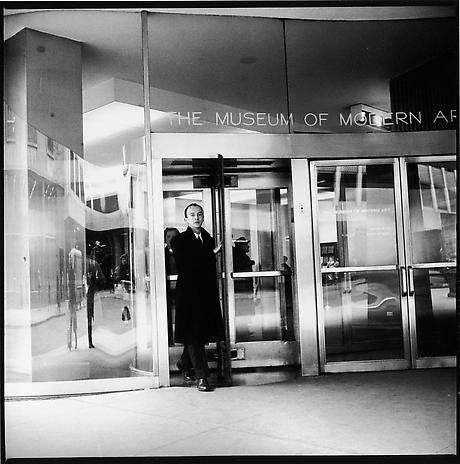
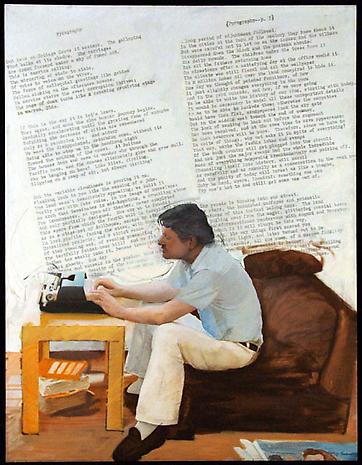
That’s Frank O’Hara, at the Museum of Modern Art. And here’s Larry Rivers’ portrait of John Ashberry:
Inscription (Ted Joans).

(scanned from Chris Felver’s book “The Poet Exposed”)
A friend is a poem: part 1 (Max Currier).
A friend is a poem is a friend is a poem, and sometimes this is true on a Monday.
TK
as my favorite poet, i thought i should send you a poem i really like. today i am making paninis with honey-mustard. i don’t know how to spell ‘panini’ and either does the computer. i miss you.
may
Snow by David Berman
Walking through a field with my little brother Seth
I pointed to a place where kids had made angels in the snow.
For some reason, I told him that a troop of angels
had been shot and dissolved when they hit the ground.He asked who had shot them and I said a farmer.
Then we were on the roof of the lake.
The ice looked like a photograph of water.Why he asked. Why did he shoot them.
I didn’t know where I was going with this.
They were on his property, I said.
When it’s snowing, the outdoors seem like a room.
Today I traded hellos with my neighbor.
Our voices hung close in the new acoustics.
A room with the walls blasted to shreds and falling.We returned to our shoveling, working side by side in silence.
But why were they on his property, he asked.
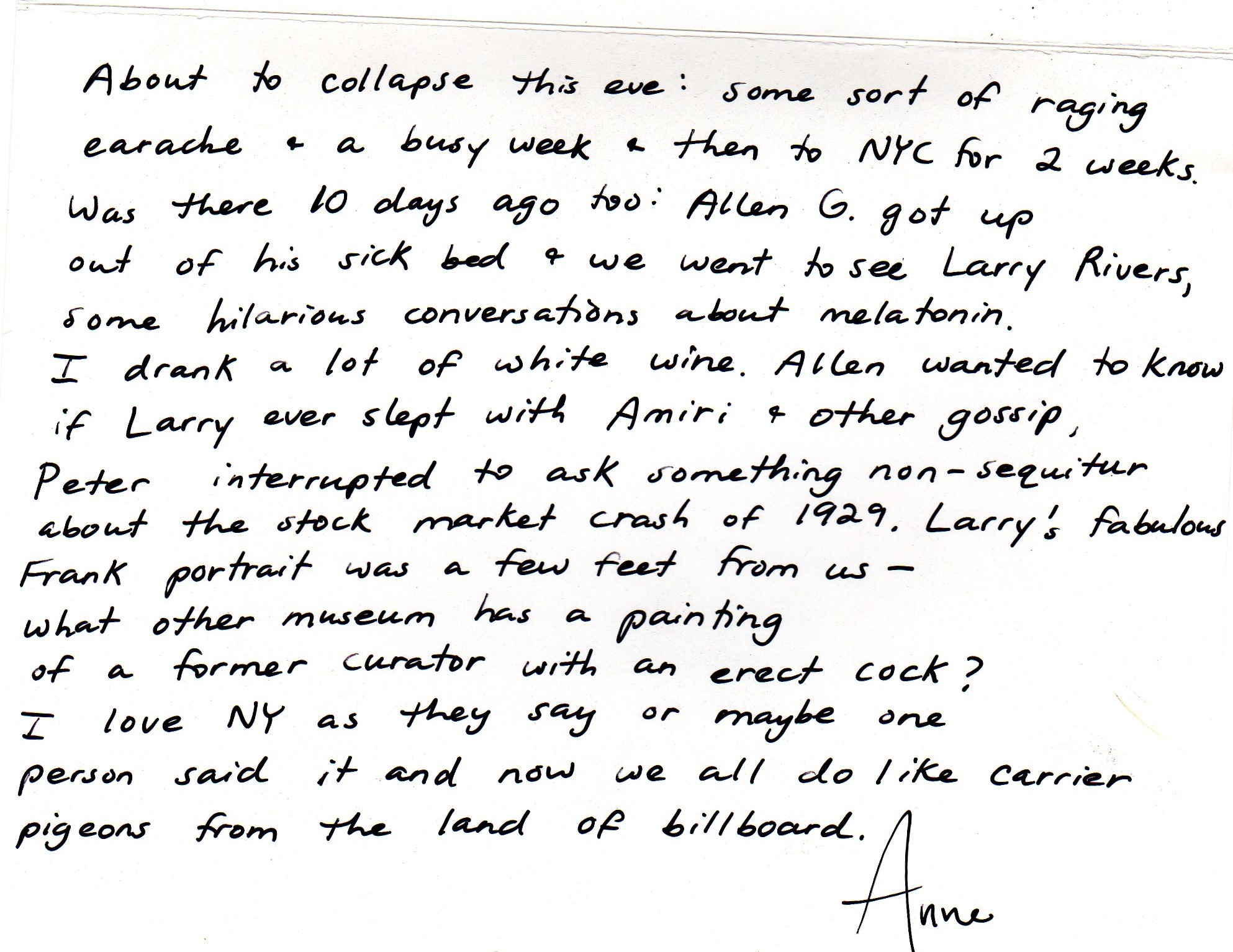
Poem based on an archived letter (mine).
A piece from my creative translation project of last semester, made up of letter poems: letters to Alice Notley, from all sorts of cool ladies, turned into poems. This one’s based off of a letter from Anne Waldman. You poets might recognize some of the names she’s referencing.
Thanks to Heather for her handwriting.
Scanner inspiration comes from Frankie.
“The Wild Party” (Joseph Moncure March).
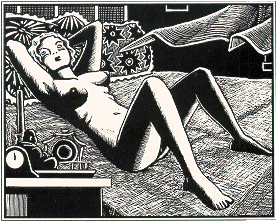
“The Wild Party” by Joseph Moncure March
Misha, in all of his wisdom, gave me a classily bound and rare (#434 out of 2,000) edition of this book for the holidays. Its pages are thick, and uneven at the edges. The author uses colons shamelessly, and well. Art Spiegelman (illustrator, author of “Maus”) rediscovered this book years ago and illustrated a new version of it (that’s where the picture above comes from). Here’s a tiny taste of the roaring twenties romp that lies between the covers (a party based on this book will undoubtedly occur at my house in the near future):
9
Some love is fire: some love is rust:
But the fiercest, cleanest love is lust.
And their lust was tremendous. It had the feel
Of hammers clanging; and stone; and steel:
And torches of the savage, roaring kind
That rip through iron, and strike men blind:
Of long trains crashing through caverns under
Grey tumbling streets, like angry thunder:
Of engines throbbing; and hoarse steam spouting;
And feet tramping; and great crows shouting.
A lust so savage, they could have wrenched
The flesh from bone, and not have blenched.
Poem (Michael Dumanis).
Memoir
There comes a point
in every story
when I panic,
there comes this panic,
I catch myself clutching
a wrench at Wal-Mart,
a wren in a field,
clutching a wrist
near a radio tower,
or someone’s key
I had not been aware of,
turning the knob
of a make-believe door.
Body the contour
of jazz in a speakeasy,
body the texture
of gasps in a gangway,
why I keep letting
you down is beyond me.
I’ve taken pains.
Practiced synchronized breathing.
Counted past ten.
Talked with zeal about things.
Even summoned the nerve
to look fetching in amber.
But can’t get past
that which rattles inside me.
Try to think back:
was I going
to flash you or juggle.
Or was there a story
I needed to tell you.
Was it important.
Could it have swayed you.
I meant to give objects
totemic significance,
refer to a childhood,
invoke certain towns.
And would I have broken
one heart or another.
It was the story of my life,
it would have started
with the note la,
then a couple of llamas.
Sometimes, a window fan
would, in it, pass for an eye.
Trust me,
it would have been riveting.
Poem that takes place in Poland (Adam Zagajewski).
Evening, Stary Sacz
The sun sets behind the market square, and nettles reflect
the small town’s imperfections. Teapots whistle in the houses,
like many trains departing simultaneously.
Bonfires flame on meadows and their long sighs
weave above the trees like drifting kites.
The last pilgrims return from church uncertainly.
TV sets awaken, and instantly know all,
like the demons of Alexandria with swindlers’ swarthy faces.
Knives descend on bread, on sausage, on wood, on offerings.
The sky grows darker; angels used to hide there,
but now it’s just a police sergeant on his departed motorcycle.
Rain falls, the cobbled streets grow black.
Little abysses open between the stones.
 panache, perhaps